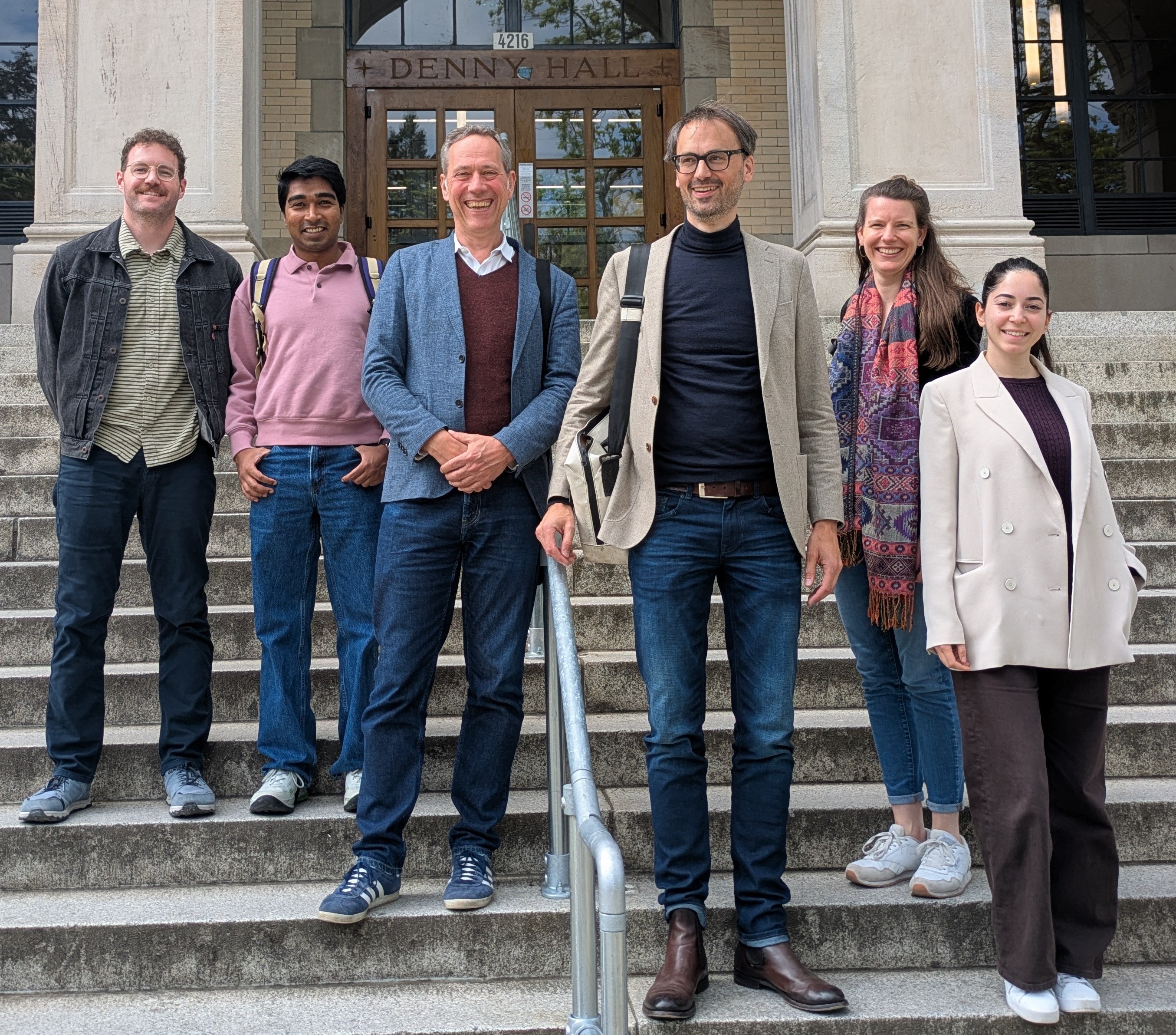
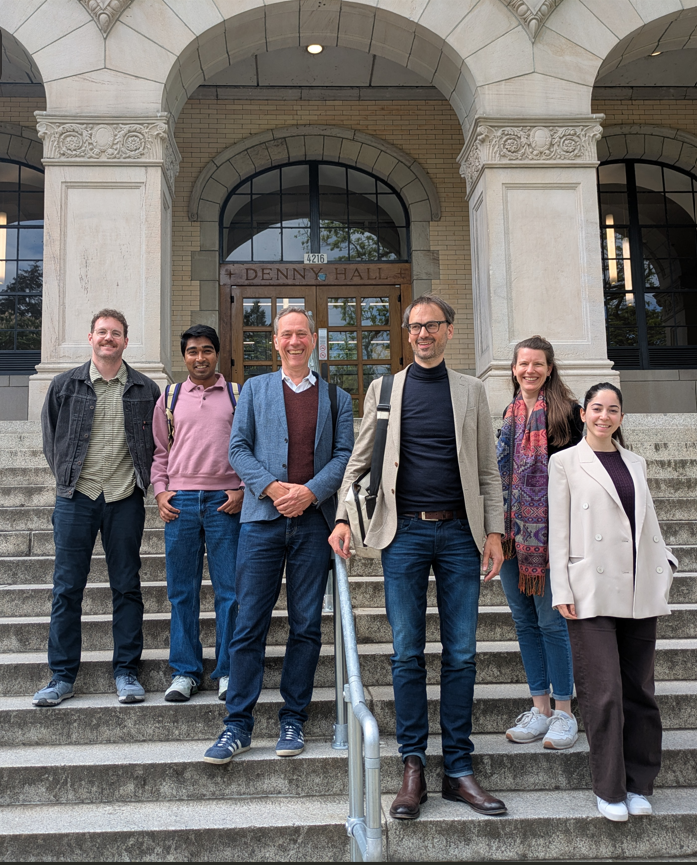
The UW German Studies Graduate Students chose Johannes von Moltke (U Michigan) as this year's Invited Speaker. On May 8, 2026, von Moltke gave a very timely -- and alarming -- talk entitled "Fascist Agitation as ‘Metapolitics’: Towards a Critical Theory of the New Right." Afterwards, doctoral candidate Inga Schwemin followed up with some further questions that resulted in this fascinating interview.
Inga Schwemin: Your research is important and timely. Could you share briefly how the term Metapolitics developed and what it encompasses.
Johannes von Moltke: To gloss the term, I often return to a saying attributed to Andrew Breitbart (founder of Breitbart News, which Steve Bannon took over after Breitbart’s death), who held that “politics is downstream from culture.” That's shorthand for an investment in cultural “hegemony,” in the ability to set the terms of cultural debate “upriver” so as to reap the results “downstream.” The phrase condenses a whole line of thought that goes back to the French nouvelle droite of the 1970s (who in turn appropriates ideas from the Marxist tradition as well as from the social movements of the 1960s) commandeer cultural positions, define the terms, expand the limits of the sayable, and control the discursive airspace - so the thinking goes - and you can march in the political ground troops.
I.S.: What are the central points you would like audiences to take away from your talk?
J.M.: Above all, I think, I’m hoping that listeners will join me in thinking through the “logics” (such as they are) of right-wing cultural production, the better to decode them for themselves. This includes also understanding that “metapolitics” often defies logic, allows two seemingly contradictory things to be true at once, and deliberately crosses political wires. Recognizing these patterns won’t mean that we can just undo them at will, but it can help us think more critically and deliberately about the values that such rhetorics would undo and dispense with: values such as deliberative debate, equity and equality, diversity and justice - and indeed democracy itself, a “value” certainly not shared widely on the far right.
I.S.: With the sheer amount of content that fits into your framework, how do you decide what deserves an in-depth analysis?
J.M.: This is a great question, the stakes for which become even higher in the age of AI, which could “ingest” way more of the material than I can. During a recent sabbatical, I’d decided to take a deep dive into Steve Bannon’s “War Room” podcast to get a sense of its politics, its populism, its propaganda, its audience address. I spent many a running session listening to episodes on my headphones (which allowed me to get the hate right out of my system through excercise…) and returning to my desk to take notes. Then, in a recent grad seminar, a student suggested running another set of materials - this time from the German context - through AI to analyze the language, the politics, the populism, the propaganda. The results were compelling, and they more or less confirmed my far more painstaking analysis of Bannon. But what I took away from the experience is that it’s less important to come to global conclusions about these questions, and to back them up with large "data sets” than to delve into the specifics and be able to account for the “fabric” of propaganda, for its textures, its feel, its local choices and strategies as much as for the recurring motifs. At that level of granular detail, the question of which sites you chose to focus on becomes less important than how you approach them.
For the rest, I try to emphasize that I’m not a journalist, and that my intention is not to “keep up” with this fast-moving material, but that I’m looking to reconstruct patterns that allow us to see a “prehistory of the present” emerge that takes us backwards from today’s “metapolticians” to the culture wars of the 1990s, from there to the nouvelle droite of the 1960s, and from there to the tentacles of fascism in both Europe and the United States during the 1930s and 1940s. In an anachronistic way (because the term wasn’t available then), I think we might even want to ask what studying the current right-wing “metapolitics” helps us newly see about those earlier periods.
I.S.: Do you have any helpful strategies to manage engaging with infuriating content you can pass on?
J.M.: Funny you should ask: at the last conference of the Society for Cinema and Media Studies, one of my grad students and I put on a roundtable devoted to just that question. We called it “Bad Object Choices” and used it to address questions that arise regularly in this line of work: how to practice a certain degree of self-care even as we travel down bewildering rabbit holes and research toxic discourses? Such research can certainly generate very real psychological effects, and occasionally researchers will articulate this in terms of the “discomfort” that their work provokes. But as my students in a recent grad seminar on “metapolitics" were quick to point out, the language of “discomfort” has no place here. If you’re not comfortable researching this, research something else – that’s part of academic freedom. Some degree of discomfort, alienation, unease, and displacement is surely a constituent part of the foundational scholarly disposition to question, interrogate, and worry an object of study until it yields insights. I try to adopt that disposition reflexively in dealing with infuriating content just as I would in dealing with any content worth studying.
I.S.: Together with family members you edited a volume of the last letters between your grandparents, the founders of the resistance group Kreisauer Kreis. In German 203, students are doing small research projects on their activism. What would you want them to know about their legacy? Could you talk a little bit about your family’s effort in preserving it?
J.M.: This is a huge question, and I’d love to direct the students straight to the book; even if you’re just able to read out editors’ introduction to Last Letters (NYRB 2019), you’ll find there a lot of what motivated me to engage with this moving and meaningful material. But to answer your question, I think what I would want people to know is that even in the darkest, most threatening times, some people (quite young at the time!) mustered the courage to resist, to think and act in a way that insisted things could be otherwise. That, in itself, was consider treason by the totalitarian regime. But it was important for those who came after, not least in the reminder that indifference is not an option.
I.S.: As the current president of the American Friends of the Deutsches Literaturarchiv Marbach, tell us a little bit about your relationship to archives? Have you come across particularly curious finds?
J.M.: Though my relationship with the archive, its vast holdings, and its wonderful people has evolved a lot since then, I first connected with the archives in the context of my research on the émigré German film and cultural critic, Siegfried Kracauer. His papers are held there (and now, so are my grandparents’ letters!) - but so is much, much more: the stacks and vaults of the archive are bursting at the seams, and they’re currently working towards the construction of a gorgeous new addition in the shape of an open book. I encourage everyone to go visit the two on-site museums (one devoted to Schiller, one to Modern Literature), and just explore the trove of manuscripts, books, photographs, letters, and objects that the archive has amassed over the years.
As for favorite finds: I think it would be a note that I found from Hannah Arendt to Siegfried Kracauer during their mutual exile from the Nazis in Paris, inviting him and his wife for tea on a certain date. To my knowledge, it’s the only physical trace we have of the two eminent critics of totalitarian culture and politics to have crossed paths. But from other biographical and bibliographical sources, we can triangulate their movements over the years to follow, up to and including their taking up residence and living out the remainder of their consequential lives on the Upper West Side of Manhattan. So from that one little note, I imagined (and wrote) a whole chapter about the parallels, coincidences, and missed opportunities that both connect and separate Arendt and Kracauer in exile.
(My all-time favorite archival find, though, came from the U.S. National Archives in Kansas City, where I found Kracauer’s application for naturalization as a U.S. citizen: it’s uncanny to hold in your hand a card of fingerprints by someone you’ve been studying closely - a physical object that he manifestly touched, and on which he left his actual imprint, reducing the degree of separation between the researcher and his object of research to something close to zero…).
I.S.: What kind of academic work do you find most fulfilling?
J.M.: Based on what I just said, I should probably say: digging in the archives. But that’s not quite true. I love reading works of well-wrought theory, and I continue to enjoy viewing and re-viewing films to discover the nuances of composition, form, narration, and the construction of meaning. But perhaps my favorite type of work is to engage closely with works by living authors and filmmakers and then entering into dialogue with them about the decisions they make, the aesthetic choices that lead to a particular turn of phrase, a chapter, a narrative, a finished film. I’ve recently had the opportunity to engage in these ways with the novelist Daniel Kehlmann as a respondent to a lecture he gave, and with the filmmaker Andres Veiel at a presentation of his new film on Leni Riefenstahl - both of these were definite highlights of my last academic year!
I.S.: Are there specific concepts you are fond of that your students or colleagues find puzzling?
J.M.: Dialectics? I’m not wedded to the notion, but I do think it’s a really good school of thought, which allows you to consider how one and the same statement might be true in one sense and false in another - and that this apparent contradiction might be resolved (“mediated”) if you can identify a different conceptual plane on which to negotiate its terms.
I.S.: If time wasn’t an issue, what is a topic you know little about and would like to learn more of?
J.M.: Another lovely question. Architecture, I think. Maybe anthropology. And I’d love to take a workshop on how to compose audiovisual essays and videographic criticism…
I.S.: What are specific things you miss about Germany and what are some you do not miss at all?
J.M.: This one feels a bit loaded, and I don’t want to slip into stereotypes here. But I do appreciate the satisfying ways in which doors and windows tend to close in Germany (more often, let’s say, than in the U.S.). And I don’t miss being reprimanded for stepping half a foot over the line of a bike path (but I do miss bike paths). More seriously: for all the diversity of American culture(s), I do miss the ability to travel – by train, and in a matter of hours – into entirely different cultural and linguistic contexts. And although I harbor no illusions that it can protect us from the encroaching return to authoritarianism that we’re witnessing all over the place, I do miss a more-than-two-party political system, in which coalitions require a different kind of political disputation (Streitkultur) and compromise. In case anyone was expecting me to say anything about food, my response would have been: it’s a wash - so much fabulous food everywhere, hooray for the variety and regional differences.
I.S.: Is there a book or film you find yourself returning to the most?
J.M.: In the 1960’s, it’s said, Theodor Adorno’s Minima Moralia was something like a bible for aspiring students and academics. That moment somewhat predates my own academic formation, but I can see why people carried the text with them “religiously”: like the bible, you can’t really read it from start to finish, and instead you return to it over and over, mining it for quotes and insights. Although Adorno articulates some infuriatingly mandarin positions in some of the aphorisms that make up the book, it does reward dipping back into ever so often. Not least, I’m sure it’s taught me ways of thinking. As for film: For many years, I made a habit of including Wong Kar-Wai’s In the Mood for Love in virtually any course I’d teach (Melodrama, Intro to Film, Film Theory…) - I just found it so endlessly enthralling. Now it’s been a while, and I’d have to rewatch it to see how it holds up. As for German cinema, I recently rewatched Christian Petzold’s Transit, a film that I thought I knew quite well and which had always left me just a little bit cold - or colder than I’d expected to be left by the work of a director I admire. But this time around, partly thanks to some of the reactions that the undergraduate students in my course on refugee films shared in class, I was quite moved, realizing how the film treats exile as a disabling condition, one in which it no longer is possible to form lasting relationships. Which is another way of saying: exile destroys sociality. There’s a deep lesson here about what it means to build a just, lasting, equitable society. (Transit also reads, we discovered, as a fascinating remake of sorts of Casablanca).