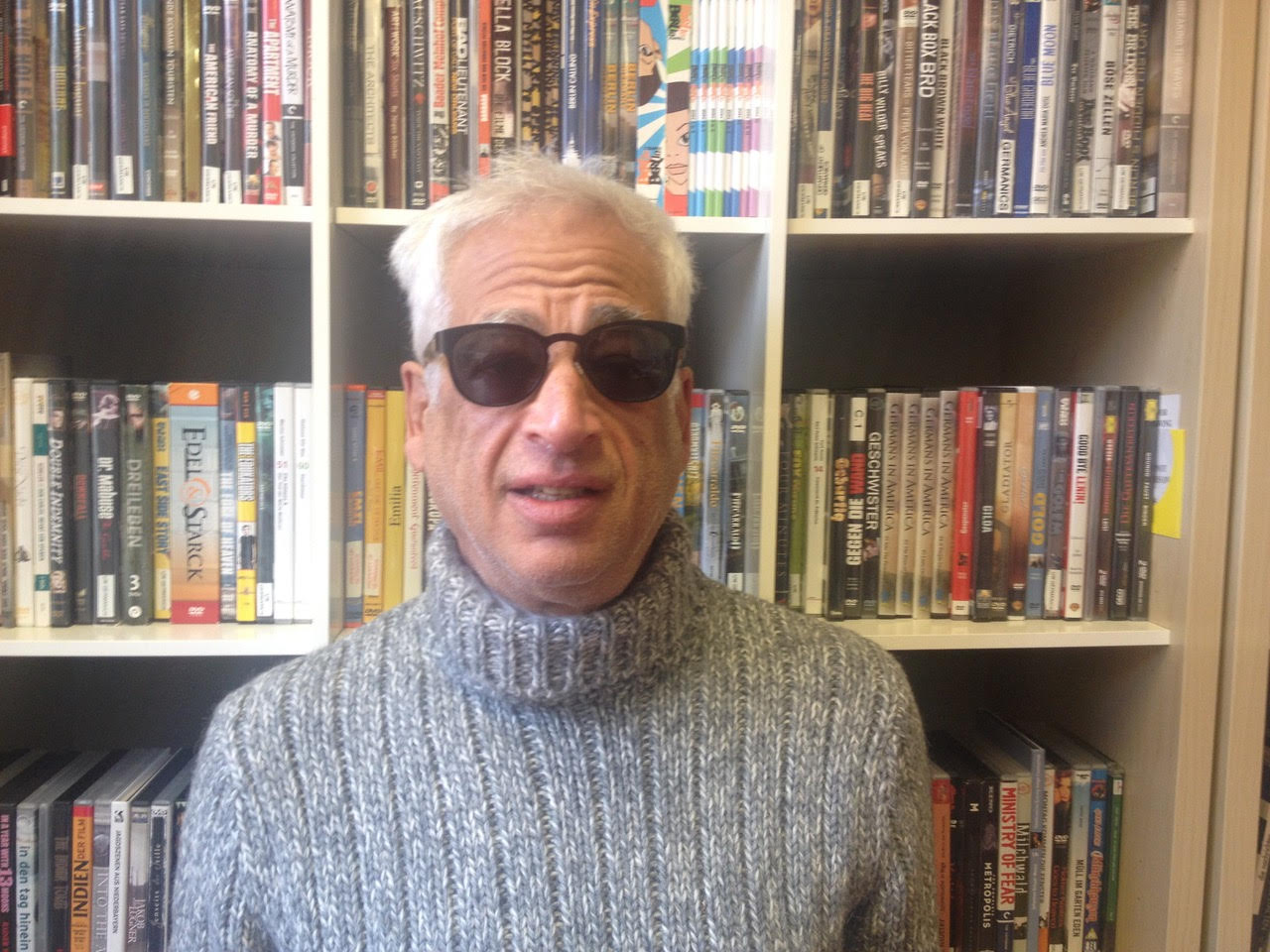
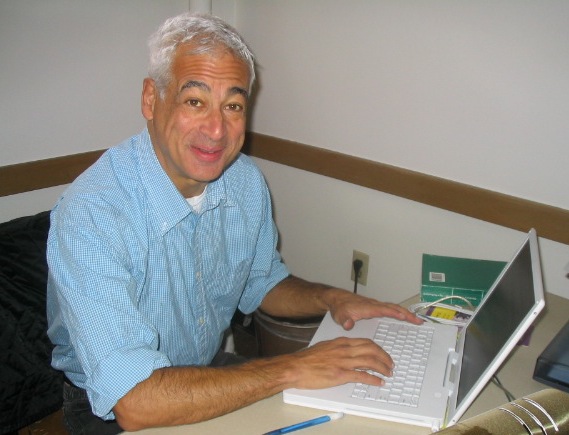
After listening to a series of moving tributes from colleagues and former students, some of whom were zooming in from distant parts, Richard Block shared his new life philosophy with the crowd of well-wishers at his retirement party: "Go back to bed!" According to Richard, this injunction encapsulates the wisdom gleaned from a lifetime of study and struggle. He promised everyone present that the "go back to bed" philosophy would help preserve their youth and keep them sane in a cruel world.
Richard came to UW in 2004, and has been an inspiring teacher and insightful scholar ever since. He taught many popular courses, such as The Queerness of Love, Film and the Holocaust, and The Human Animal (check out this blog entry by a student in this course who writes about Richard as "a mad genius"). Richard's most recent book, Echoes of a Queer Messianic: From Frankenstein to Brokeback Mountain (SUNY 2018) is emblematic of the way he is able to weave together creative close reading and complex theoretical interventions in a deft and beautiful dance. In his retirement, he is poised to make the promise of his first book come to pass: The Spell of Italy: Vacation, Magic, and the Attraction of Goethe (Wayne State UP 2006) examines Italy as a phantasmic space that gave rise to an aesthetic ideal often leading to disillusion. In his retirement speech, Richard invited us all to visit him in Rome, but warned that if he doesn't answer the doorbell it's because he's followed his own advice and gone back to bed. He is thus once again casting an Italian spell and setting us all up for disappointment!
Memories and tributes from colleagues:
From Jane Brown:
Richard was one of the colleagues I felt closest to. We socialized and shared a love for cats and a general love for the arts and musical culture, design, intellectual breadth, and a willingness to transgress boundaries--all this said with acknowledgment of my frequent failings to appreciate contemporary culture. He was the colleague who did most to broaden my horizons and to stretch my appreciation in all directions--the qualities I have always appreciated most in my teachers and colleagues.
From Jason Groves:
My first memory of Richard is from a hotel room in Vancouver. It must have been 2015. Back then, many initial job interviews for faculty positions were conducted at the annual conference of the Modern Language Association, typically in a bedroom or suite where a faculty member was staying. This was rather unnerving for job candidates, probably for interviewers too. It didn’t help my nerves that one of my interviewers in that bedroom was Richard Block, whom I’ve come to know to be an extremely quick-witted person. I had sent in a writing sample about, among other things, Goethe’s fascination with geological formations known as erratic blocks, and I had rehearsed a series of answers to stock questions. What I wasn’t prepared for was the very first question from Richard Block, no doubt delivered with a characteristic smirk: You know I’ve always thought of myself as a sort of erratic block. So how did you happen to arrive at this research topic? It was a particularly disarming question, because I sensed an invitation that went well beyond my research, and I desperately wanted to offer up a repartee, but I came up empty and stammered out something that I’m glad to have forgotten. In fact, Richard’s remark is the only thing that I remember from that interview. Since then, we’ve had some great banter, and I’ve even left Richard speechless with a zinger or two, but he usually gets the last word.
From Ellwood Wiggins:
I first heard Richard's voice while I was failing to install an infant car seat in the small town in Kentucky where we lived at the time. He was calling to invite me to an initial interview for a position at UW, but he didn't say so right away. Instead, as I fumbled with the baffling mechanisms of the car seat, he said that the search committee had been interested in my dissertation topic and launched into a complex, insightful critique of the underlying concepts of my research, culminating in a brilliant suggestion for a book title: "Casualties of Recognition." I'm sure I stammered something unintelligible in response, and ended the call convinced that there was no way they were going to give me that job! Fourteen years later, I count myself fortunate to have had countless interactions with Richard similar to that first encounter: surprising, somewhat unnerving, always witty and often brilliant. His departure will make Denny Hall a measurably less fun place to work.
Memories and tributes from students for whom Richard served as Doktorvater (dissertation adviser):
Nathan Bates (PhD UW 2018)
Richard was a very perceptive and attentive dissertation advisor. He always knew somehow when I had reached an impasse or had fallen behind on a chapter, and it seemed to be more than coincidence when he would run into me in Denny Hall. Then he would offer some sage advice, much of which I still employ today, and recommend more things to read that I would ever have time to digest. In our formal advising sessions, he always found a way to guide me out of my own self-made Unmündigkeit with clarity and encouragement, and I cherish those memories.Outside of advising, one of my favorite things about Richard was watching him during Q&A sessions after guest lectures or public events. Richard had a remarkable gift for asking difficult questions, which caused the presenter to pause and reflect before asking him to repeat them. And then, he would either rephrase his question with remarkable alacrity or ask a whole new question which would completely transform the perspective in the room.I especially loved the wry smile he’d get when he knew he had truly challenged a claim or shifted the paradigm. When that smile appeared, you knew someone was in for a real intellectual reckoning. In our Heidegger seminar, I can remember having many similar experiences. Richard might occasionally choose to step back from a debate, but it almost never felt like he lost one.On this happy occasion to celebrate Richard's successful career, I extol his insight, his erudition, and his passion. His ability to guide both discussions and people make him a truly exceptional scholar. My best wishes and hopes for this new phase of his life. In particular, I hope he can spend many enjoyable days in his beloved Italy.
Lena Heilmann (PhD UW 2014)
I have so many good memories of Richard  ! He was so supportive of me while I was working on my dissertation and helped me conceptualize a more compelling framework. He pushed me to expand how I was thinking about my project.
One thing I really appreciated was when, pretty soon after my sister died, I had a job interview at the MLA. We chatted about it, and he shared something along the lines of, well, you won’t be as nervous as the others, because you know that the job interviews aren’t a big deal, compared to your loss. And it was true. I’ve also carried that sentiment with me ever since, in different iterations. Everything that is “stressful” is less stressful than losing a loved one.
Richard could see through the ritualized academic stress and understood what real life was, and for that I am so grateful. Without his perspective and understanding of what I was going through regarding my grief for my sister, I would have not been able to finish my PhD 
Japhet Johnstone (PhD UW 2015)
My first graduate seminar with Richard was on Heidegger and poetry. It was a daunting course. But Richard’s indefatigable exacerbation with Heidegger and his deft ability to weave in humor at just the right moment combined to make it one of the most memorable classes I’ve ever taken. The neuronal networks and intellectual friendships I formed during that quarter would continue to shape my future in ways that I couldn’t have imagined at the time. I am forever grateful to Richard for forging those bonds at a very formative time in my life.
Richard has since continued to be a source of support and encouragement. In addition to supervising my dissertation and helping me navigate the job market after graduation, he has been a generous and patient friend over the years. While our contact has certainly been sporadic, he has provided me with words of wisdom in times that I needed them most – often with that same mix of humor and exacerbation that I came to appreciate when I met him at the beginning of graduate school.
Congratulations, Richard, on your retirement! And thank you for never losing faith in that kid from Missouri! Come visit Berlin sometime soon!
Jan Hengge (PhD UW 2010)
Richard probably doesn’t remember this, but one of my fondest memories of working with him
comes from a morning when he rushed into my office, eager to share what he called a
breakthrough in my dissertation. He was so absorbed in his new insights that he failed to notice
the disaster behind me: a full cup of coffee had spilled across my teaching materials, and I was
due in class in ten minutes. I stood there stressed and scrambling, while Richard explained his
insights with the excitement of someone who couldn’t wait to share his ideas. In many ways,
that moment distilled what I appreciated most about him: his passion, his curiosity, and the way
his mind could eclipse everything else.
That passion was matched by his often sarcastic humor and a refusal to align himself with
whatever counted as mainstream academic thinking at the time. Richard pushed boundaries.
His ideas were unconventional, sometimes radical, but always generative. It was his
encouragement to interrogate assumptions rather than accept them that shaped my dissertation
on revolutionary dramas and the moments in literature and film that break from the status quo.
Richard didn’t just allow for unconventional thinking, but he insisted on it.
I first met Richard at the University of Colorado in the early 2000s and we both moved to Seattle
in 2004, where our paths continued to intersect in meaningful ways at the University of
Washington. He taught me to think differently and critically. These are skills that continue to
shape my work outside of academia today. I’m grateful for his guidance, his humor, and his
uncompromising commitment to curiosity. I congratulate him warmly on his retirement.